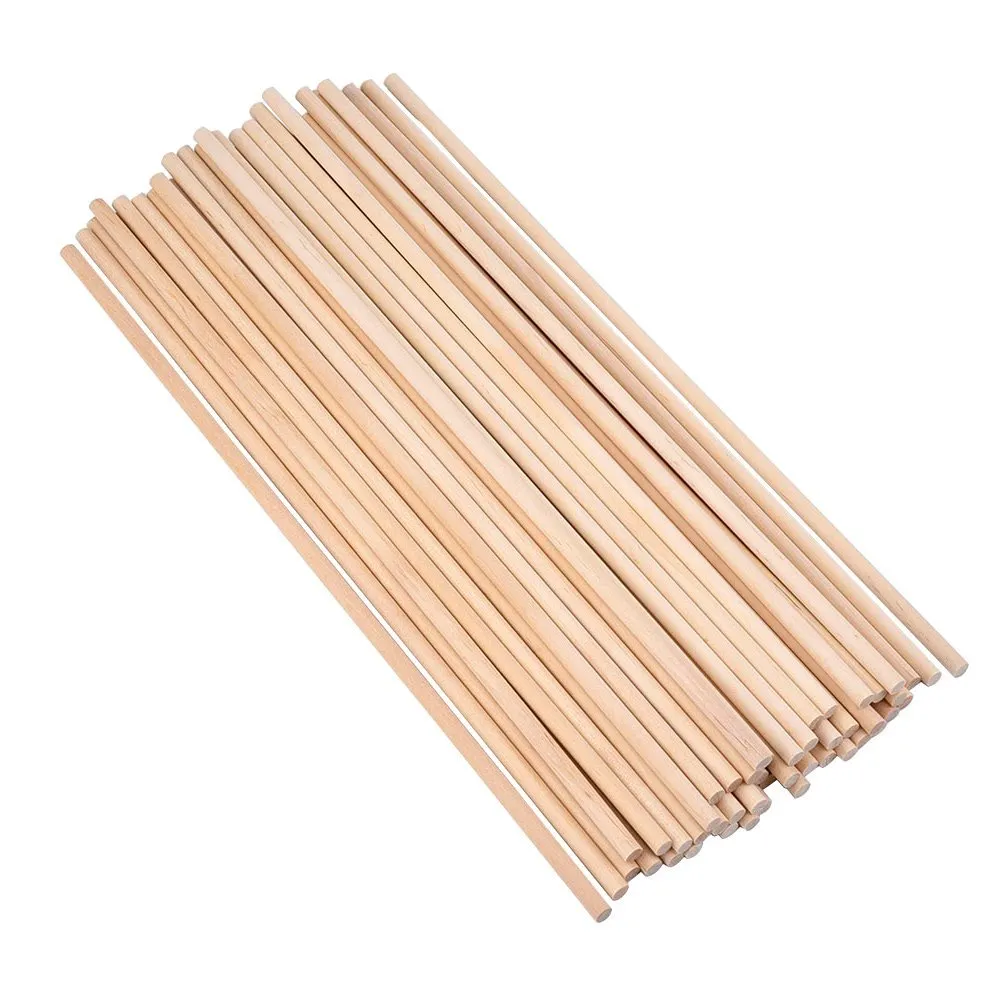
Wooden dowels are a natural choice for struts. Wood is fairly easy to work with and fairly durable. Dowels come in a variety of diameters and lengths, and can be purchased from most hardware stores; however, dowels of a small diameter from the hardware store are often not very straight. I have had luck with alternate sources of dowels, such as dowels for arts and crafts for children, or campfire roasting sticks. I avoid bamboo dowels and sticks because from past experience I don't feel that holes through the end grain will hold up well.
Miscellaneous
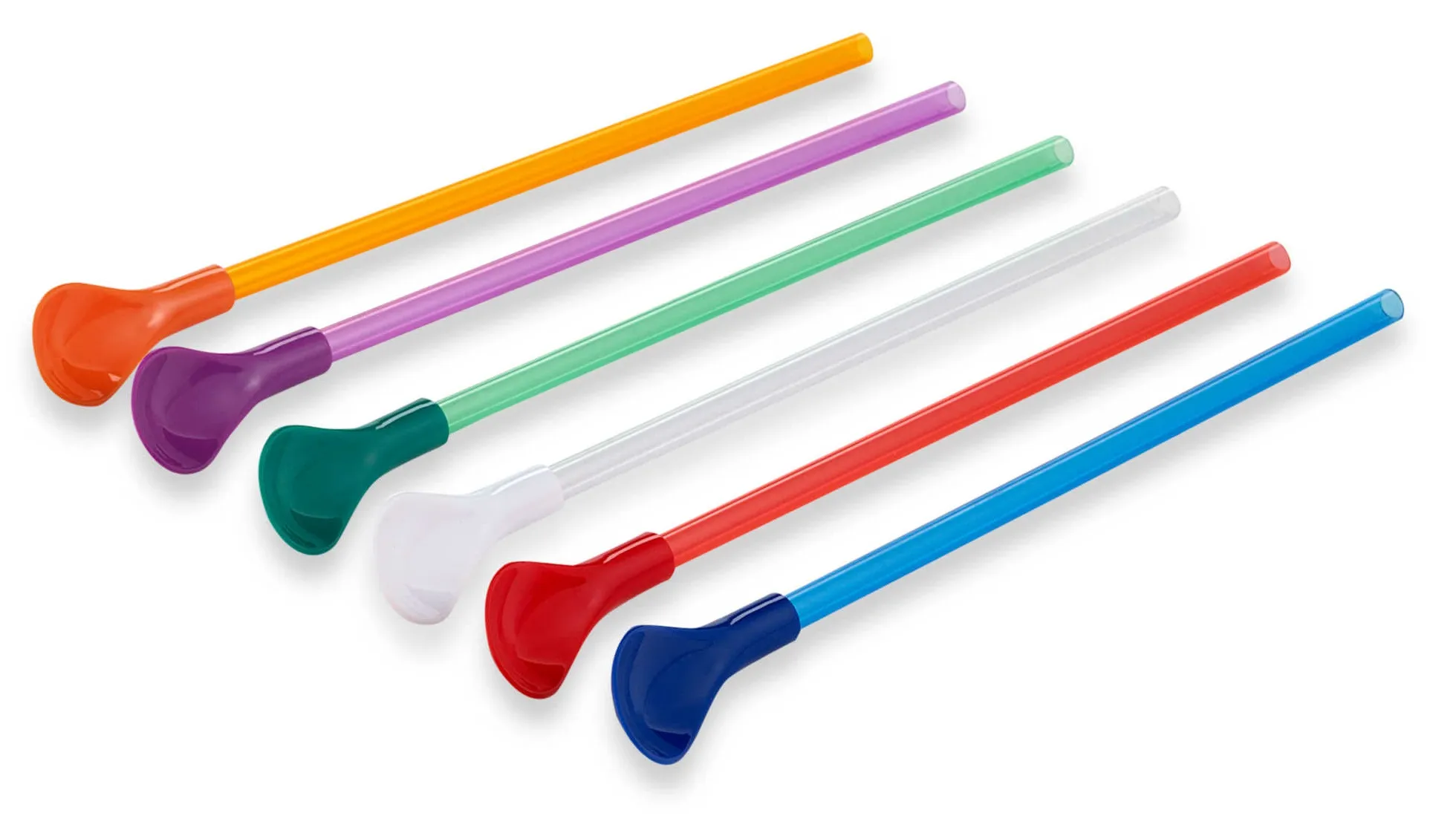
Some children's spoons also have a built-in straw. They are made with a hollow tube for the handle. Detaching the scoop end of the spoon yields a hollow, colored, semi-transparent plastic cylinder.
Tendons
Fishing Line
I use various types of fishing line for the tendons in my tensegrities. I stay away from the clear, single-strand plastic (monofilament) fishing line because of how difficult it is to work with. Instead I use braided fishing line at various weights.Most of my tensegrities are made with Woodstock 130 pound test braided Dacron deep water fishing line. This line is a white sixteen-strand braid that is fairly easy to work with.For smaller tensegrities I use Piscifun braided fishing line, which comes in several colors including white and black. Their 50 pound test line is a four-strand braid and their higher weight lines are eight strands, which I don’t have experience with.
Connectors
Washers
Washers (flat washers, not split washers) are a good choice for tensegrities assembled with the net mesh approach. In such constructions a net of tendons is assembled into which struts will be inserted.
Beads
Flat washers are hard to purchase at below 7mm outer diameter. Stainless steel ring or spacer beads can be much smaller and work well.
Screw Eyes
Screw eyes are closed metal loops with a thread that can be screwed into the end of dowels.
A drill is used to put holes into the ends of dowels. It can also be used for sanding, by clamping a dowel into the chuck (with padding to keep the chuck jaws from marking the dowel) and running the drill while pressing the dowel into sandpaper.
Saw
A small saw is used to cut dowels to length.
Ruler
A ruler is necessary for measuring tendon and strut lengths.
Sandpaper
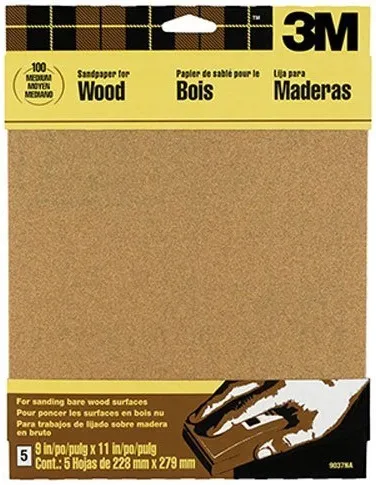
Sandpaper of a coarse grit can be used to incrementally reduce the length of wooden dowels, allowing for adjustments of fractions of millimeters at a time.Fine grit sandpaper is used to put a smooth finish on the dowels once the essential structure has been resolved.
Pencil Sharpener
A pencil sharpener can be used to put a taper on the ends of the dowels.
Pin Vise
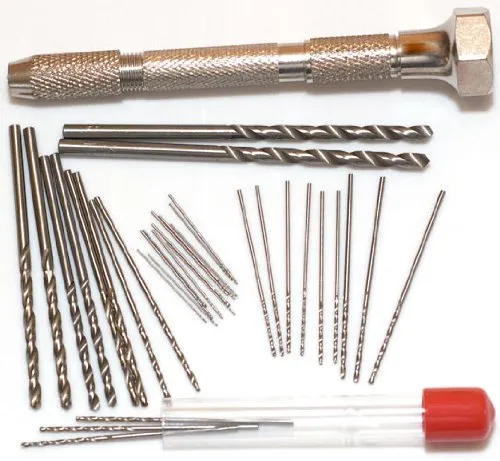
A small hand drill is useful for starting holes in the ends of dowels. Doing so is not strictly necessary, but helps with producing a centered hole in the end of the dowel, which is a difficult task. It is possible to do this without a hand drill, by pressing a nail into the end of the dowel.
There are several ways to put tensegrities together.
Tendons Tied to Strut Ends
This method involves tying tendons directly to the ends of struts. The struts can have either screw-eyes, screws, or nails driven into their ends, to which tendons are tied.
Continuous Tendon
As a variation of tendons tied to strut ends, it is sometimes possible to tie all tendons with a single continuous strand. This is possible if all (or all but two) of the strut ends attach to an even number of tendons, because in doing so the tendons form an Eulerian Path. This manner of construction can produce the least bulk at the ends of the struts and the cleanest-looking models, but is difficult to physically execute.
Individual Tendons
In this approach, individual tendons are fashioned that have loops at both ends. The tensegrity is assembled by adding each tendon and strut one at a time. For struts that terminate in a nail or screw, the tendons can be a single piece of cord with loop knots or washers at each end.
Mesh–Net
The mesh net approach involves forming a mesh or net of tendons and connectors into which struts can be inserted. The number of washers will equal twice the number of struts if each tendon directly connects two strut ends. Tendons are tied to washers instead of directly to the ends of struts. The struts can then be added to the mesh by inserting a nail or screw through the washer and into the end of the strut. The resulting structures can be quickly broken down and re-assembled, allowing for easy storage and transport, and replacement of damaged struts.
To construct rigid tensegrities, one must use a non-elastic rope, cable, or some type of cord for the tendons. The tendons must be very close to a precise length, and tying or fastening the cord to a fixed length can be challenging. In this section I will make use of terminology from knot tying, which can be referenced here.
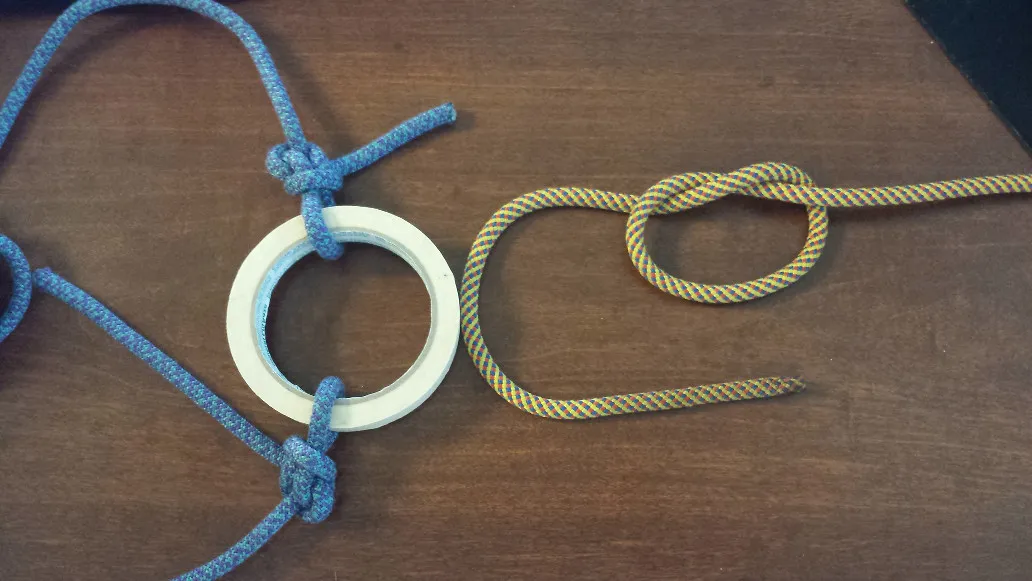
The major difficulty is that most knots are not well-suited to controlling the length of the standing end. Even if the length is carefully controlled while the knot is being tied, once it is tightened, slack can appear. The solution that I have adopted is to use a knot called the Angler’s loop (or perfection loop). This knot has a structure that works well for adjusting the length of the standing end. Basic instructions for tying the knot can be found here.
The perfection loop contains a simple overhand knot which is basis for its easy length adjustment. The strategy is to adjust and cinch down the overhand knot until the proper length is achieved, and then to pull the slack out of the knot into the tail while keeping the overhand knot tight. This preserves the length of the standing end.
This knot can be tied several ways to suit different situations that arise when building tensegrities.
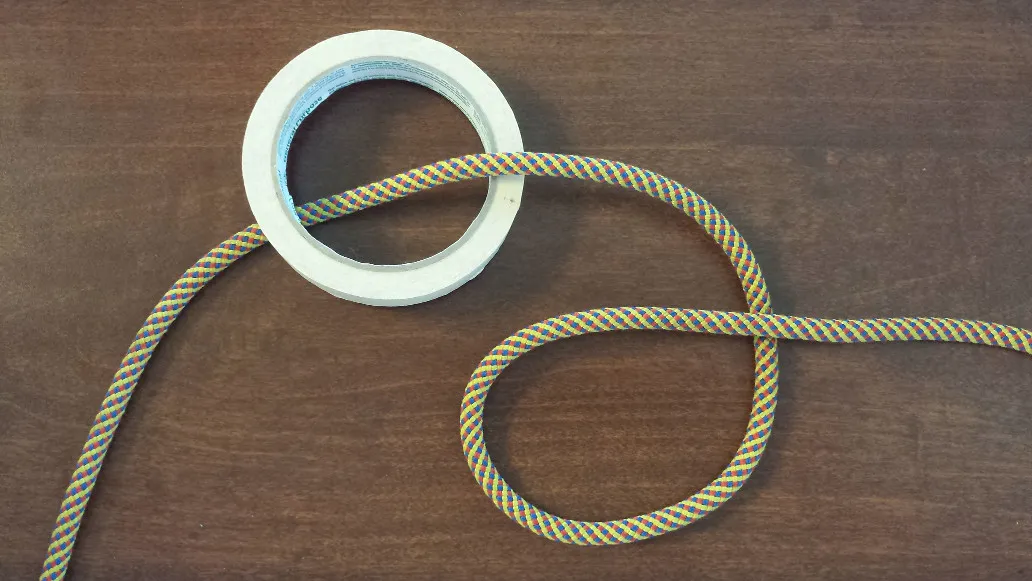
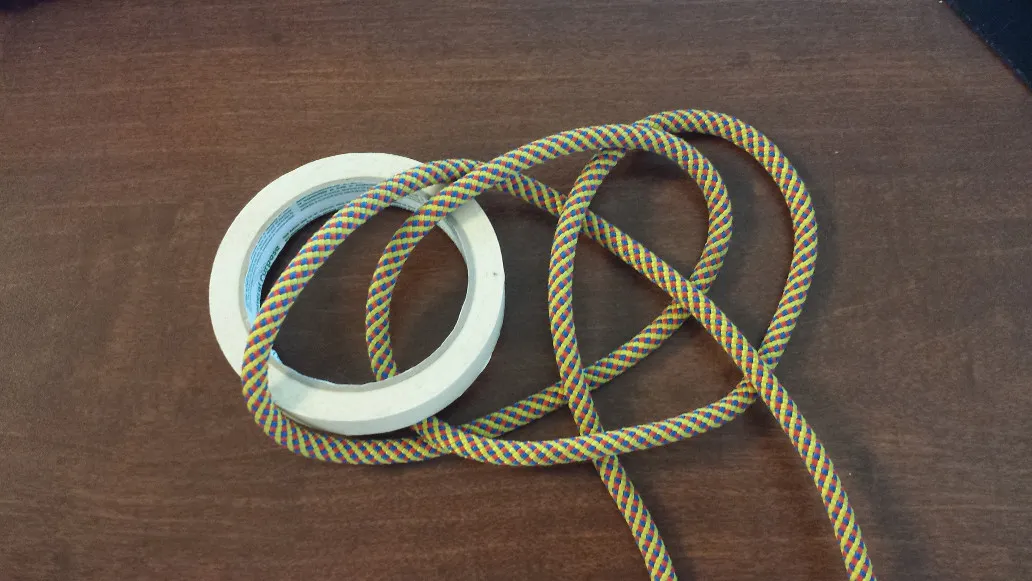
With the Ends
Here we have access to an end of the rope and wish to form the knot. This the less restrictive situation.
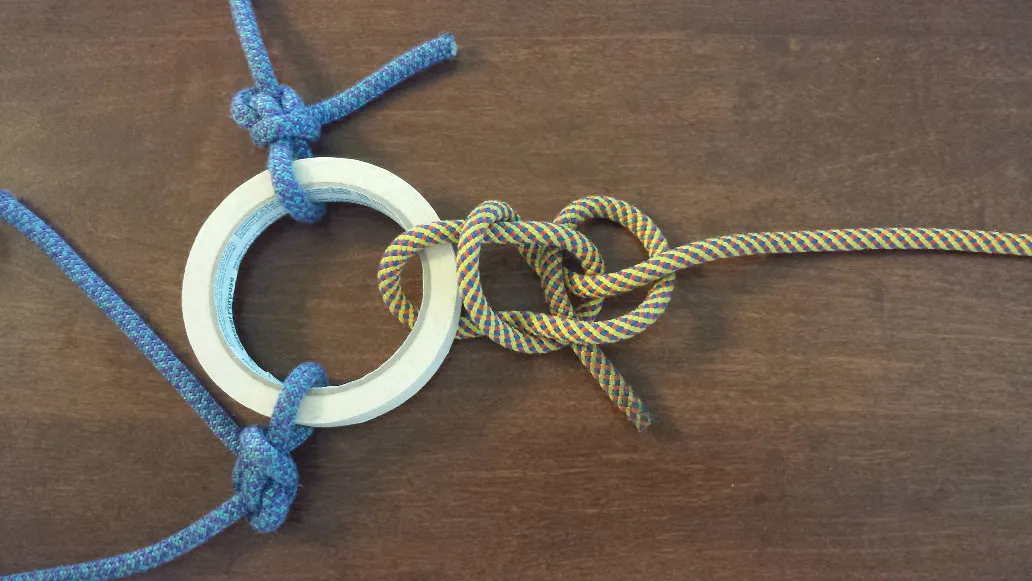
In the Bight
The bight refers to any portion of the rope that is not either end. Tying in the bight means to tie without access to the ends: you cannot pass the end through the knot or pass the knot around the end. The rope must still be passed through the washer, but the creation of the knot does not involve weaving the end through the knot. Instead, various loops must be formed and passed through each other.
I generally prefer to use this method as much as possible because I find it to be faster. Early in the construction of the mesh there are few topological restrictions and so this method can be used.